Development Blog - Page 4
Further simplification of the circuit. This time a single resistor was removed with no change in functionality. While not much, this has allowed for a connection pin count to be reduced as well as a reduction in board size. v0.9f of the PCB is now 1.69" x 1.04" - 1.74in2.
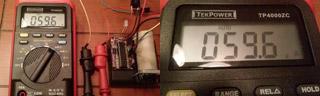
Did a bunch of detailed power usage tests which confirm the ultra-low power usage. While in normal dog monitoring mode, it only uses 59.6μA (microamps), or 0.0596mA (milliamps)! Including the status LED that flashes every 8 seconds and assuming 10 alarms per day, it adds up to an average of only 62.5μA. With standard AA alkaline batteries, this works out to about 5 years of constant usage (realistically, more like 3-4 years once battery self-discharge is factored in).
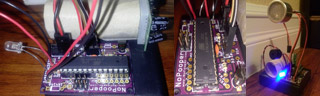
Working prototype from v0.9d PCB. Finally gone is the solderless breadboard with all the wires. Works great and no issues. Here's a
video of it in action.
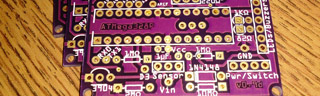
Received the first batch of prototype PCBs - v0.9d. Very nice and production was fast enough to run through several prototypes without much delay. v0.9e prototype PCB are coming from a fabrication lab in China. They're less expensive, but shipping is slow and we'll see about the quality.
Simplified the hardware in two areas to keep production costs as reasonable as possible. First, the status/info LED and flasher/alarm LED were combined to one LED with some clever manipulation of port modes. Secondly, a unique way to monitor the voltage was discovered that doesn't require two voltage divider resistors. In all, 3 components were removed which will lower production costs, reduce board size and complexity, higher accuracy, and uses less power. Board size down to 1.75" x 1.12" - 1.96in2 (not bad for a through-hole prototype with no surface mount components).
Navigation:
« Page 3 | Page 4 |
Page 5 »